
Resolving Causality in Multi-Device Messaging Synchronization
Achieving consistent message thread state across multiple concurrent client sessions requires moving away from simple timestamp-based ordering toward vector clocks or logical sequence numbering to resolve causality in distributed environments.
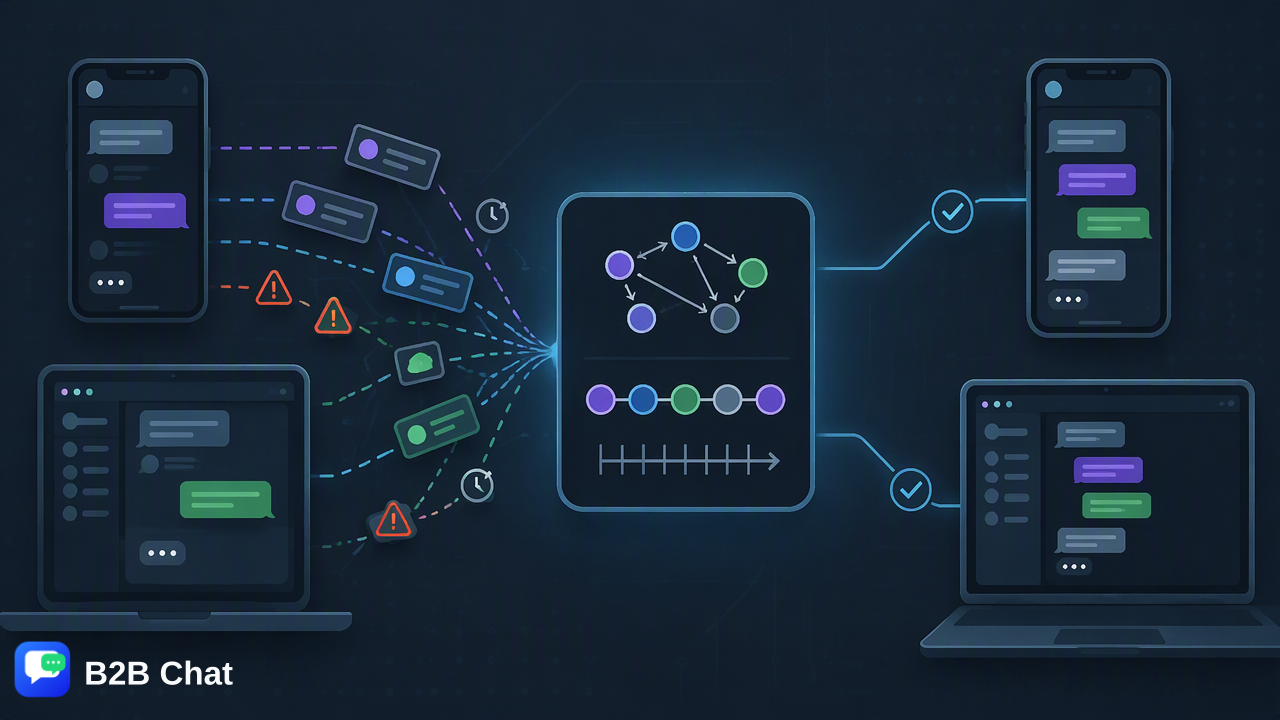
In distributed messaging systems, the illusion of a linear conversation is fragile. When a user interacts with a service through both a desktop client and a mobile device, the backend often receives events that appear to violate temporal order. If your system relies on wall-clock timestamps to sequence messages, you are likely encountering "ghost" replies—where a reply appears before the message it references—or intermittent reordering during periods of high network jitter.
This article explores the transition from timestamp-based ordering to logical causality tracking, framed as an engineering experiment to stabilize multi-device synchronization.
The Baseline: The Fallacy of Synchronized Clocks
Our initial implementation relied on the server-side ingestion timestamp. When a message arrived, the server assigned it a created_at value. We assumed that because the server was the single source of truth for ingestion, the order of arrival would represent the order of intent.
The failure mode became apparent during a period of high concurrent usage. A user would send a message from their mobile device while simultaneously receiving a notification on their desktop client. Due to network latency, the mobile message would reach our ingestion endpoint slightly after a background sync process had already processed a different event. Because the mobile device’s local clock was slightly ahead of the server’s clock, or because the network path for the mobile packet was delayed, the database would record the reply with a timestamp that placed it chronologically before the parent message.
This resulted in a broken UI state where the thread view would render the reply as an orphan or place it at the top of the conversation history.
The Experiment: Logical Sequence Numbering
To address this, we moved away from wall-clock time and implemented a logical sequence numbering system. The hypothesis was simple: if every message carries a reference to the "previous" message ID in the thread, the client can reconstruct the conversation tree regardless of the order in which packets arrive at the server.
The Smallest Useful Experiment
We introduced a parent_id field and a sequence_number field in our message schema.
- The client maintains a local counter for the current thread.
- Every outgoing message includes the ID of the last message it successfully received.
- The server validates that the
parent_idexists before committing the new message to the database.
If the server receives a message with a parent_id that does not yet exist in the database, it places the message in a "pending" buffer rather than immediately broadcasting it to other sessions.
The Surprising Result
The experiment revealed a significant edge case: The "Self-Correction" Loop.
When a user sends a rapid burst of messages from a mobile device, the client might send Message B before the server has finished acknowledging Message A. Under our new logic, Message B would be buffered because its parent_id (Message A) was not yet "committed." This caused a perceptible delay in message delivery, even when the network was fast. We had traded "out-of-order" messages for "delayed" messages.
The Failed Approach: Global Locking
To fix the delay, we briefly considered a global lock on the thread during ingestion. We attempted to use a distributed lock (via Redis) to ensure that messages were processed strictly one by one per thread.
This failed under load. The overhead of acquiring and releasing locks for every single message in a high-concurrency environment introduced a bottleneck that increased the latency of the entire messaging pipeline. Furthermore, if a client lost connection while holding a lock, the thread would effectively freeze until the lock timed out, creating a poor user experience.
The Refined Approach: Vector Clocks
We eventually moved toward a simplified version of vector clocks. Instead of a single sequence number, each client session maintains a version vector: a map of {device_id: counter}.
When a message is sent, the client attaches its current vector. The server compares the incoming vector with the existing state of the thread.
- If the incoming vector is a direct successor to the current state, the message is accepted.
- If the vector indicates a gap (e.g., the server sees a counter of 5 but the client sends 7), the server requests a re-sync of the missing messages from the client.
This approach allows for concurrent message ingestion from multiple devices without requiring a global lock. It acknowledges that in a distributed system, causality is a partial order, not a total one.
Limits and Trade-offs
While vector clocks solve the causality issue, they introduce complexity in the client-side implementation. The client must now be capable of:
- Buffering: Storing messages that arrive out of order until the missing causal links are filled.
- Reconciliation: Merging the state when a device reconnects after being offline.
The primary trade-off is storage and bandwidth. Attaching a vector to every message increases the payload size. For a high-volume system, this metadata overhead must be weighed against the cost of re-syncing entire threads.
Furthermore, this approach does not solve the "clock skew" problem for the display of messages. Even if the causal order is correct, the UI still needs to display a timestamp for the user. We decoupled the causal order (used for thread structure) from the display time (used for the UI). The display time is now a hybrid: the server provides a "logical timestamp" that is monotonically increasing, ensuring that even if the wall-clock time is skewed, the UI renders messages in the order they were processed by the system.
Conclusion
The transition from timestamp-based ordering to logical causality tracking is a necessary evolution for any system supporting multi-device synchronization. By moving the responsibility of ordering from the server's clock to the message's causal metadata, we eliminate the ghost-reply phenomenon.
However, this is not a silver bullet. It requires a robust client-side architecture capable of handling buffering and state reconciliation. As you implement these patterns, remember that the goal is not to force a perfect global order, but to maintain a consistent causal history that matches the user's intent. Always test your synchronization logic against high-latency, high-concurrency scenarios, as these are where the assumptions of linear time most frequently collapse.