Engineering Reliable Message Delivery in Distributed Systems
Achieving reliable message delivery in distributed conversational systems requires a deliberate trade-off between strict consistency and system availability, specifically when choosing between client-side acknowledgment tracking and server-side sequence validation.

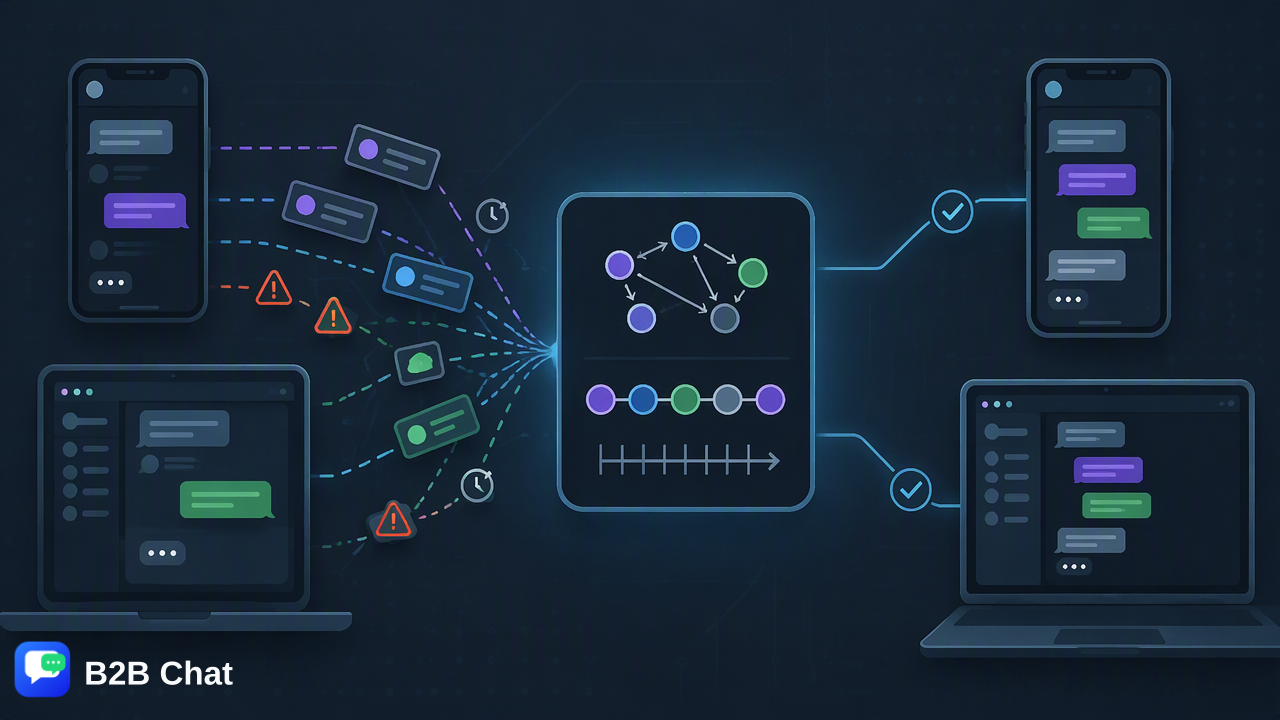
In distributed conversational systems, the challenge of ensuring a message reaches its destination is rarely about the network itself. Instead, it is a problem of state synchronization between the client, the load balancer, and the backend persistence layer. When a user hits "send," the system must decide how to handle the acknowledgment of that message.
The choice between a "fire-and-forget" approach and a strict "at-least-once" delivery model is not merely a preference; it is a fundamental trade-off between system availability and data integrity.
The Fire-and-Forget Model with Client-Side Retries
In a fire-and-forget architecture, the client sends a message to the server and assumes success unless it receives an explicit error response. If the connection drops or the server times out, the client is responsible for retrying the operation.
Implementation Mechanics
The client generates a unique identifier for the message locally. It sends the payload to the server. If the server processes the request, it persists the message and returns a success code. If the network fails before the client receives that code, the client triggers a retry.
Trade-offs and Limitations
The primary advantage here is low latency. The server does not need to perform complex coordination or check for duplicate message IDs before acknowledging the receipt. This reduces the load on the database and minimizes the round-trip time for the user.
However, this model introduces a significant edge case: the "zombie message." If the server successfully persists the message but the network connection breaks before the acknowledgment reaches the client, the client will retry. Without server-side idempotency, the system will store the same message twice.
A surprising observation in high-concurrency environments is that network partitions often occur after the server has processed the request but before the response is routed back. In this scenario, the fire-and-forget model inevitably leads to duplicate data unless the client-side retry logic is paired with a server-side deduplication mechanism.
The At-Least-Once Delivery Model with Idempotency Keys
To guarantee that a message is delivered and persisted exactly once, architects often move toward an at-least-once delivery model. This requires the server to participate in the acknowledgment process by validating the state of the message before committing it to the database.
Implementation Mechanics
The client attaches an idempotency key—usually a UUID—to every message. When the server receives a request, it first checks its persistence layer to see if a message with that specific key already exists.
- If the key is new, the server processes the message and returns an acknowledgment.
- If the key exists, the server ignores the write operation and returns the existing message record to the client, effectively "acknowledging" the previous successful attempt.
Trade-offs and Limitations
This approach provides high data integrity. It eliminates the risk of duplicate messages, which is critical for conversational systems where order and uniqueness are expected.
The trade-off is increased latency and complexity. Every incoming message now requires a read operation (the idempotency check) before a write operation can occur. In a distributed cluster, this check must be consistent across nodes. If the system uses a distributed cache or a database to track these keys, the latency of that lookup becomes a bottleneck. Furthermore, the server must manage the lifecycle of these keys—eventually, you must prune old idempotency keys to prevent the storage layer from growing indefinitely.
Comparison of Delivery Strategies
| Feature | Fire-and-Forget | At-Least-Once |
|---|---|---|
| Latency | Low (Single write) | Higher (Read-before-write) |
| Data Integrity | Risk of duplicates | Guaranteed uniqueness |
| Complexity | Low | High (Requires key management) |
| System Load | Minimal | Increased (Lookup overhead) |
Choosing the Right Strategy
The decision between these two models depends on the specific requirements of the conversational flow.
When to Choose Fire-and-Forget
This model is appropriate for systems where the cost of a duplicate message is lower than the cost of increased latency. For example, in a real-time status update or a non-critical notification system, a duplicate message might be a minor annoyance that the UI can handle by filtering based on timestamps. If your system architecture prioritizes responsiveness and can tolerate occasional duplicates, fire-and-forget is the more efficient choice.
When to Choose At-Least-Once
This model is necessary for transactional or state-sensitive conversations. If the message represents a command, a financial transaction, or a critical customer service interaction, duplicates can lead to incorrect state transitions or confused users. If your system requires strict consistency, the overhead of idempotency keys is a necessary cost.
The Middle Ground: Sequence Validation
Some systems implement a hybrid approach using sequence numbers. Instead of full idempotency keys, the server tracks the last received sequence number for a specific conversation thread. If a client sends a message with a sequence number that the server has already processed, the server rejects it.
This is more efficient than a global idempotency check but requires the client to maintain a strict state of the conversation history. If the client loses its local state, it may struggle to determine the correct next sequence number, leading to synchronization errors.
Final Considerations for Distributed Clusters
Regardless of the chosen strategy, distributed systems face the challenge of clock skew and network jitter. Relying on client-side timestamps for ordering is rarely sufficient. When implementing acknowledgment tracking, ensure that your persistence layer handles concurrency correctly.
If you are using a distributed database, consider the impact of your consistency settings. A system that acknowledges a message before it is fully replicated across the cluster may still lose data during a node failure, even if the client received an acknowledgment. Always consult the documentation for your specific database and messaging infrastructure regarding their consistency guarantees and timeout behaviors.
Ultimately, there is no "correct" answer. The best approach is to define the acceptable failure modes for your specific use case. If you can survive a duplicate, optimize for speed. If you cannot survive a duplicate, optimize for integrity and accept the latency cost of server-side validation.