Resolving Message Sequence Drift in Distributed Conversational Streams
When distributed systems process asynchronous messages, network jitter and race conditions often lead to out-of-order delivery; this article provides a technical framework for implementing vector clocks and sequence validation to ensure message integrity in multi-client environments.

In high-concurrency messaging systems, the assumption of linear time is a luxury that distributed architectures rarely afford. When a user interface displays a "message read" receipt before the corresponding message payload has arrived, the resulting state divergence is more than a cosmetic annoyance—it is a symptom of a fundamental breakdown in causal ordering. This article explores the mechanics of this drift and provides a framework for implementing deterministic sequencing.
The Anatomy of a State Divergence Incident
Consider a scenario where a client application maintains a local cache of a conversation thread. The backend service processes incoming messages from multiple sources, including automated translation modules and intent-recognition engines.
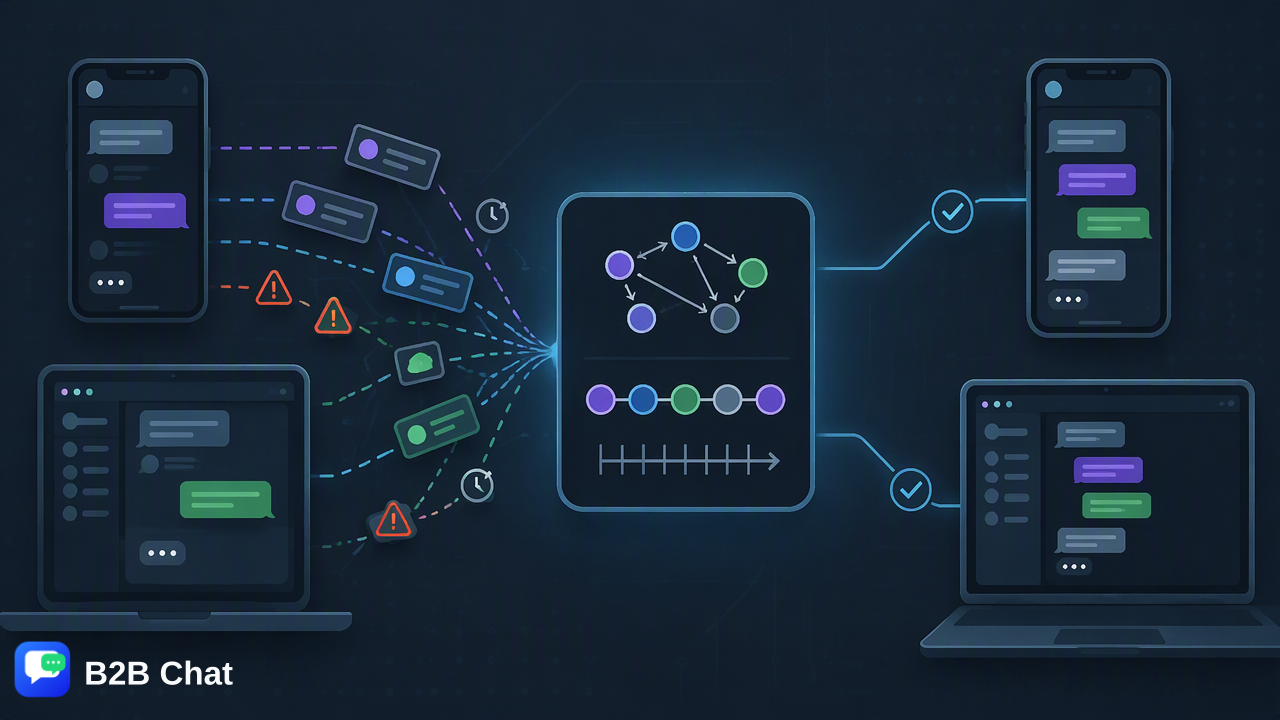
During a recent incident, users reported that their chat windows would flicker, showing a "read" status indicator for a message that did not yet exist in the local message store. Upon investigation, the root cause was identified as a race condition between two asynchronous event streams: the message delivery pipeline and the metadata update pipeline.
The message delivery pipeline was responsible for pushing the raw content to the client, while the metadata pipeline handled status updates like "delivered" or "read." Because these pipelines operated on different worker threads and utilized different message queues, the metadata update—which was smaller and processed faster—frequently bypassed the primary message payload. The client, receiving the metadata first, attempted to update the UI state for a message ID that had not yet been committed to the local database, leading to a null-pointer exception in the rendering logic and a subsequent UI flicker.
Identifying the Misleading Signal
The core issue is that distributed systems often rely on wall-clock timestamps to order events. However, in a multi-node environment, clock skew between servers is inevitable. Even with Network Time Protocol (NTP) synchronization, the granularity of system clocks is often insufficient to distinguish between events occurring in rapid succession.
When the metadata service and the message service operate independently, they lack a shared causal context. The metadata service "knew" the message was read, but it had no mechanism to verify if the client had already received the message content. Relying on arrival time at the client is equally flawed, as network jitter can reorder packets in transit, regardless of the order in which they were dispatched from the server.
Implementing a Deterministic Sequencing Layer
To resolve this, we must move away from wall-clock time and toward logical clocks. A robust approach involves implementing a versioning system that enforces causal dependencies.
1. Vector Clocks for Causal Tracking
A vector clock allows each node in the system to maintain a counter for every other node. When a message is sent, the sender attaches its current vector clock. The receiver compares this clock with its own. If the incoming message's vector clock indicates that it depends on a previous message that has not yet been received, the client can buffer the metadata update until the missing message arrives.
2. Sequence Validation
In addition to vector clocks, every message should carry a monotonically increasing sequence number scoped to the conversation ID. The client-side state manager should implement a "pending buffer." If a metadata update arrives for a sequence number $N$, but the local store only contains up to \(N-1\), the update is placed in a queue. Once the message with sequence $N$ is processed, the buffer is flushed, and the metadata update is applied.
Trade-offs and Limitations
While this approach ensures integrity, it introduces specific trade-offs:
Latency Overhead: Buffering messages to ensure order introduces a slight delay in UI updates. In high-concurrency environments, this is usually preferable to state corruption, but it must be balanced against the user's expectation of real-time responsiveness.
Memory Pressure: If a client experiences significant packet loss or out-of-order delivery, the pending buffer can grow. A strict eviction policy is required to prevent memory exhaustion, which may involve requesting a full state synchronization from the server if the gap between sequence numbers becomes too large.
Boundary of Applicability: This framework is effective for ordered conversational streams but is less suitable for systems where eventual consistency is prioritized over strict ordering, such as high-volume telemetry or logging streams where individual message loss is acceptable.
Edge Cases and Counterexamples
A common pitfall is assuming that sequence numbers can be global. In a distributed system, generating a global, strictly increasing sequence number requires a centralized sequencer, which becomes a single point of failure and a performance bottleneck.
Instead, sequence numbers should be scoped to the specific conversation or thread. This allows for horizontal scaling, as different threads can be processed by different nodes without contention. However, this creates an edge case: what happens when a user switches devices? If the client-side state is not synchronized across devices, the sequence validation logic may fail when a user moves from a desktop client to a mobile client. In such cases, the server must be capable of providing a "state snapshot" that includes the latest sequence number for the thread, allowing the new client to resume from a known good state.
Operational Considerations
When integrating these mechanisms, developers must be mindful of the underlying infrastructure. For instance, when using external APIs for translation or intent recognition, the latency of these third-party calls can exacerbate the sequencing problem. If an API has rate limits that restrict requests per minute, or if concurrency is limited, the resulting backpressure can cause the message pipeline to stall while the metadata pipeline continues to flow.
Always consult the current API documentation for applicable limits to ensure that your sequencing logic does not inadvertently trigger rate-limiting penalties. Furthermore, ensure that your client-side implementation handles the "gap" scenario gracefully—if a message is permanently lost, the client must have a mechanism to detect the missing sequence and request a retransmission or a full state refresh.
By shifting the responsibility of ordering from the network layer to the application layer through logical clocks and sequence validation, you can transform a fragile, jitter-prone stream into a deterministic, reliable conversational experience. The goal is not to eliminate network jitter—which is impossible—but to build a client-side state machine that is resilient to the inherent chaos of distributed communication.